
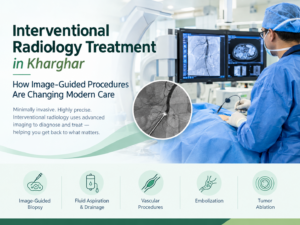
Medical imaging is no longer used only to diagnose a disease. With advances in interventional radiology, imaging can also help doctors perform targeted procedures with small needles, wires and catheters. This approach can be used for diagnosis, treatment, fluid drainage, blood-vessel procedures and selected cancer treatments.
For patients looking for Interventional Radiology Treatment in Kharghar, understanding how these procedures work can help them discuss appropriate options with their doctor.
What Is Interventional Radiology?
Interventional radiology is a medical specialty that uses imaging guidance to perform minimally invasive diagnostic and therapeutic procedures. Depending on the procedure, doctors may use ultrasound, CT, MRI or X-ray/fluoroscopy to guide instruments to a specific area of the body.
Instead of making a large surgical incision, many interventional procedures use a small skin opening through which a needle, catheter or other device is introduced. The imaging system allows the doctor to monitor the position of the instrument during the procedure.
The exact technique depends on the condition being treated, the location of the target area and the patient’s overall health.
Why Is Image Guidance Important?
Accurate positioning is an important part of many interventional procedures. Real-time or repeated imaging can help the interventional radiologist identify the target and guide the instrument toward it.
For example, ultrasound can provide real-time visualization during certain biopsies, fluid drainage procedures and injections. X-ray and fluoroscopy can be used to navigate catheters through blood vessels, while CT can help guide needles toward specific tissues or lesions.
This combination of imaging and minimally invasive techniques has expanded the role of interventional radiology in modern healthcare.
Common Interventional Radiology Procedures
The procedures available depend on the expertise and facilities of the centre and the patient’s medical requirements. Common categories include:
Image-Guided Biopsy
When a tissue sample is needed for diagnosis, imaging can help guide a needle to the area of concern. Ultrasound or CT may be used depending on the location and characteristics of the lesion.
The collected tissue is then examined in a laboratory to help establish a diagnosis.
Fluid Aspiration and Drainage
Interventional radiology can also be used to remove abnormal collections of fluid or pus from selected areas of the body.
Imaging guidance helps the doctor position the needle or drainage catheter accurately. In some situations, a catheter may remain in place for continued drainage.
Vascular Procedures
Interventional radiologists can perform procedures involving blood vessels. Angioplasty, for example, uses a balloon catheter to open a narrowed blood vessel, and a stent may sometimes be placed to help maintain blood flow.
Other vascular procedures include catheter-directed treatment of selected blood clots and embolization procedures.
Embolization
Embolization involves intentionally blocking a selected blood vessel using an embolic material or medication. It can be used in several clinical situations, including treatment of certain bleeding conditions, vascular abnormalities and selected tumors.
During catheter embolization, imaging is used to guide a catheter through the blood vessel to the treatment site.
Tumor Ablation
Some selected tumors can be treated using image-guided ablation techniques. Depending on the condition, procedures may use heat, such as radiofrequency or microwave ablation, or extreme cold through cryoablation.
Ultrasound, CT or MRI can help guide the probe to the target tissue.
Recent Developments in Interventional Radiology
Interventional radiology continues to develop as imaging technology and treatment techniques improve. Current areas of interest include more precise image guidance, advanced CT and MRI techniques, tumor ablation and image-guided cancer treatments.
One emerging area is histotripsy, which uses focused ultrasound energy to mechanically disrupt targeted tissue rather than relying on thermal energy. Interest in this technology is growing, although its role depends on the specific condition, available technology and clinical indications.
Another developing area is image-guided pain management. Recent work has highlighted the use of targeted nerve blocks performed with imaging guidance as part of minimally invasive pain-management approaches.
These developments demonstrate how interventional radiology is moving toward increasingly targeted procedures while maintaining the importance of careful patient selection and specialist expertise.
Is Interventional Radiology Less Invasive Than Open Surgery?
Many interventional radiology procedures are minimally invasive and use small skin openings rather than large surgical incisions. Depending on the procedure, this may mean less disruption of surrounding tissue and a shorter recovery period than some open surgical approaches.
However, this does not mean that interventional radiology is appropriate for every patient or every condition. Some patients may still require conventional surgery or other forms of treatment.
The choice depends on the diagnosis, treatment objective, anatomy, previous treatment, overall health and recommendations from the treating medical team.
What Happens During an Interventional Radiology Procedure?
The process varies considerably between procedures. In general, the patient is positioned on an examination or procedure table. The treatment area is cleaned and prepared, and local anaesthesia or sedation may be used when appropriate.
The interventional radiologist then uses the relevant imaging method to guide the needle, catheter or other instrument toward the target. After completing the procedure, the instrument is removed and the access site is treated appropriately.
For some procedures, patients may be monitored for a period before going home. More complex procedures may require additional observation or hospital care.
Who May Need Interventional Radiology Treatment?
Interventional radiology may be considered for selected patients who require:
- Image-guided tissue sampling
- Drainage of fluid or abscesses
- Treatment of selected blood-vessel problems
- Catheter-based vascular procedures
- Embolization
- Selected tumor ablation procedures
- Certain image-guided pain procedures
The appropriate treatment should always be determined after reviewing the patient’s symptoms, medical history, imaging findings and other relevant investigations.
Choosing Interventional Radiology Treatment in Kharghar
When considering Interventional Radiology Treatment in Kharghar, patients should look for appropriate imaging facilities, trained specialists, procedure-specific expertise and proper pre- and post-procedure care.
It is also important to understand what procedure is being recommended, why it is required, what preparation is needed, and what potential risks or alternatives may apply.
Interventional radiology has become an important part of modern medicine by combining diagnostic imaging with targeted treatment. As imaging technology and minimally invasive techniques continue to develop, these procedures are creating additional treatment options for appropriately selected patients.
If your doctor has recommended an image-guided procedure, discuss the specific procedure, expected benefits, possible risks, alternatives and recovery requirements with your treating healthcare professional.